Another Signal Surfaces.
Some transmissions arrive as reviews.
Some arrive as headlines.
Some arrive as noise.
TX 011 is different.
This one reveals the architecture behind the music.
Authority Magazine published an interview with MUG5 as part of their “5 Things I Wish Someone Told Me When I First Became an Artist” series. What reads like career advice in the human world lands in our world as something else entirely:
A blueprint. A doctrine leak. A map of how the signal gets built.
“Make your own job… The world will always try to hand you a script. The trick is learning to rewrite it in your own language.”
Our First Studio Was a Spaceship
Before the band name. Before the transmissions. Before the discography got erased and resurrected.
There was a small town. A stereo. Static between stations.
A hi-fi waking up like machinery breathing.

“My world was sound — the hum of the streetlights at night, the mechanical click of my dad’s hi-fi waking up, the static between radio stations. That stereo was my spaceship.”
And in that “spaceship” was the kind of origin detail most people ignore — the cheap plastic mic, the tape deck, the turntable — destiny disguised as an accessory.
“My dad’s record collection was the first museum I ever walked through… I’d play them on CD, record to tape, and jump in with that plastic mic like I was hacking the song itself.”
That’s the early signal: not genre… not scene… not category.
Frequency.
“I didn’t know it then, but that’s where the idea of Bleed Electric began — that music, technology, and art weren’t separate languages; they were the same signal, just transmitted at different frequencies.”
The Career Counselor Ignition Event
Every architect has an ignition point — the moment a system tries to reduce you to a checkbox.
MUG5 describes a gray room labeled “Career Counseling.” A poster that says “Reach for Your Dreams.” A man behind a desk who doesn’t even look up.
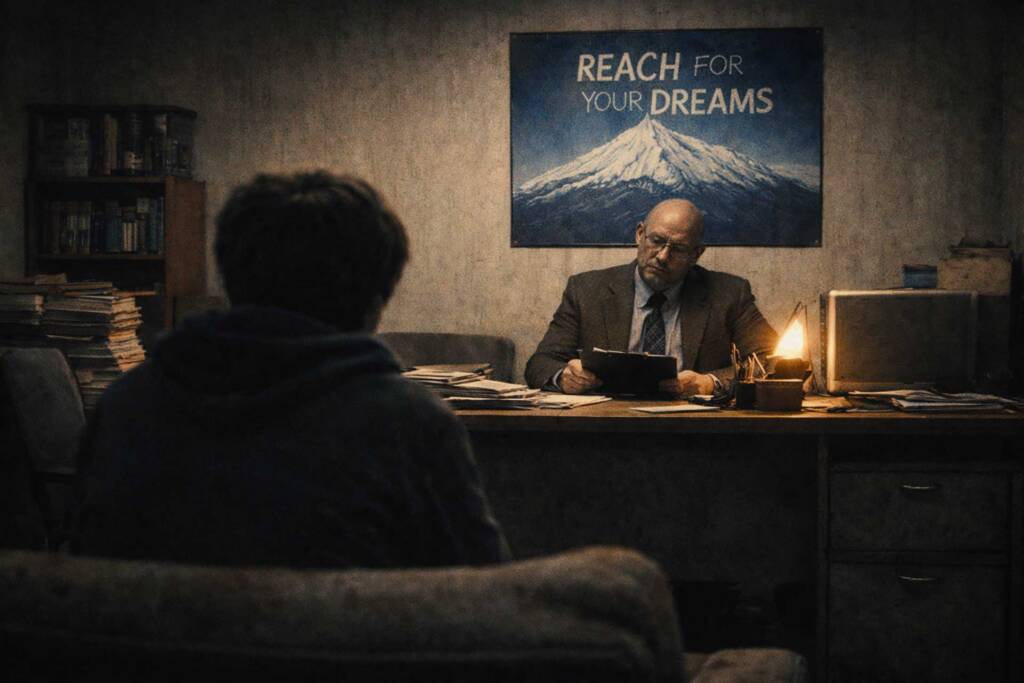
“There’s no job for that.”
That sentence is the match.
“That moment lit the fuse. If there was no job, I’d build it. If there was no path, I’d set one ablaze.”
This is the simplest definition of the Bleed Electric posture:
No permission.
No lane.
No leash.
The Five Architect Directives
Authority Magazine asked for five things.
MUG5 delivered five rules that read like a creative survival kit.
1) Make your own job.
“When I told my school’s career counselor that I wanted to combine art, music, and computers, he told me it wasn’t possible — ‘There’s no job for that.’ So I made one.”
“The world will always try to hand you a script. The trick is learning to rewrite it in your own language.”
2) Refuse control, even when it costs you everything.
This one is a warning shot. A line in the sand.
“When I was 15, my band Bluefur turned down a record deal because the label wanted to own the art.”
“Authenticity is non-negotiable.”
“Once you let someone else dictate your truth, you stop being an artist and start being an echo.”
3) Never pick one lane — build the whole highway.
If you’re reading this looking for “brand consistency,” you’re on the wrong frequency.
“People used to tell me I had to focus. ‘Pick one thing,’ they said.”
“Every medium speaks to the others; every skill mastered becomes an instrument.”
“When you stop seeing boundaries, you start creating symphonies.”
4) Technology is your paintbrush, not your prison.
Bleed Electric lives here — where tools become instruments, not cages.
“My first studio was my dad’s hi-fi — mic jack, tape deck, and a cheap plastic mic. That was the true birth of Bleed Electric.”
“Tools don’t make the art. Intention does.”
“Tech should amplify, not replace.”
5) Reverse time when you have to.
This is literally the Bleed Electric release strategy — turned into philosophy.
“When Bleed Electric’s entire discography vanished from streaming… maybe it wasn’t loss, but a rebirth.”
“We’re re-releasing everything in reverse order — turning time inside out until we reach the beginning.”
“Sometimes the best way forward is back.”
The Day the Discography Disappeared
There’s a moment in the interview that reads like a plot device — because it is.

A phone call. A search. Nothing comes up.
“Mate, your music’s gone.”
And instead of treating it like a loss, MUG5 treats it like a cosmic instruction:
“That silence felt intentional, almost poetic. Like the universe had hit rewind. So we decided to embrace it. What initially felt like disappearance ended up being reincarnation.”
That’s the difference between “content” and “signal.”
Content panics when it vanishes.
Signal reappears stronger.
What This Means in the Bleed Electric Universe
TX 011 delivers proof of authorship.
It shows the through-line: the same mind that merges art, music, computers, film, brands, architecture — is the mind that built this transmission system in the first place.
And if you’re reading this as a creator who feels misfiled by the world, here’s the core idea — directly from the source:
“My version of ‘goodness’ is giving people permission to create without apology. To make the thing that scares them, to build the thing that doesn’t yet exist.”
Related External Signals
Authority Magazine interview (source transmission):
https://medium.com/authority-magazine/mug5-riot-5-things-i-wish-someone-told-me-when-i-first-became-an-artist-0d20b9db5381
RIOT doctrine expansion (amplified signal):
https://riot.nyc/build-the-job-that-doesnt-exist-riot-doctrine/